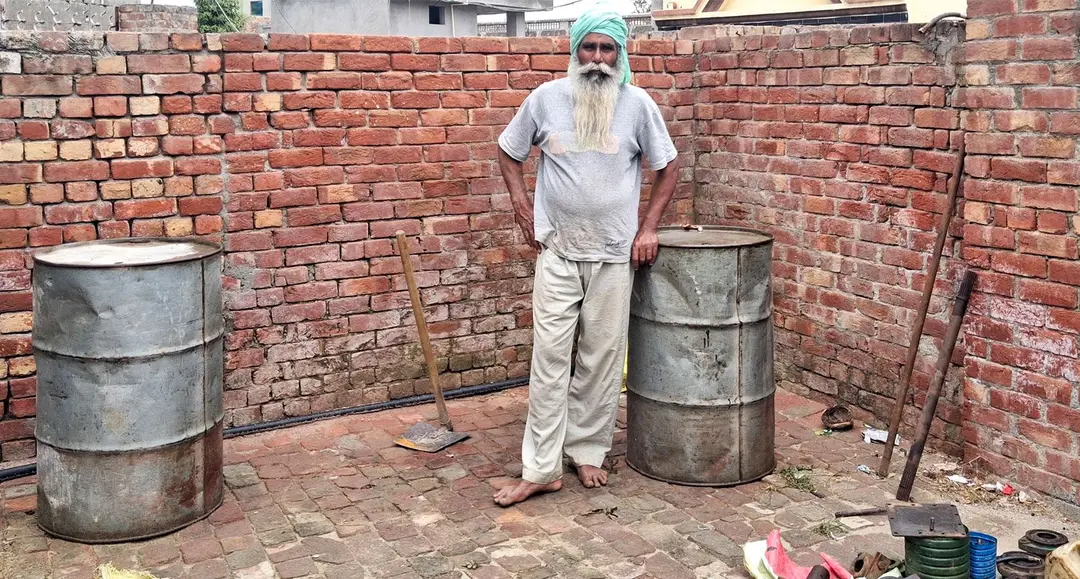
As the lush green wheat fields turn to gold, so do the worries of Dalbara Singh mature. Soon, it’ll be harvesting time. Soon diesel won’t be just a fuel, but a lifeline. That is why this landless Dalit farmer in Barnala district’s Patti village unhesitatingly borrows money at an annual interest rate of 18 percent to make sure his diesel drum remains full.
Dalbara Singh, 55, along with his three brothers, tills the 20 acres he has taken on lease from an NRI. And also works on the lands of others during harvesting season as a ‘custom harvester’ to reap wheat straws for dairy farmers. He points to his tractor and reaper. “These are guzzlers. If run on full capacity, this drum of diesel will last just two days.”
But borrowing money at such a high rate? “What other option did I have? What if I don’t find diesel a week later? My entire crop will rot. I have raised it like a child,” he says. Calculating Dalbara’s income seems hard when he hasn’t had any for over a year. His losses and borrowings keep mounting.
For farmers in Punjab, the US-Israel war on Iran means more debt. But it’s an even bigger crisis for Dalbara Singh and many others like him, whose children work in gulf countries as labourers and semiskilled workers. The war threatens their future too. Only last month, he borrowed Rs. 4 lakh to send his son to Cyprus, a West Asian country (though geopolitically considered part of Europe) dependent on tourism and shipping. The ongoing war has hit both those sectors. “But my son is not happy as he couldn’t find work. So now he’s restless, wanting to return,” he says. Dalbara innocently blames his own destiny and doesn’t once mention the war in our entire conversation.
With the wheat harvesting season nearing, and the uncertainty created by the war, many farmers began buying diesel in advance from a fortnight ago. You can see long lines of tractors with empty diesel drums placed on their rear jacks queuing up at filling stations. “They are all borrowing money at a hefty interest rate,” says Raghbir Singh Dakala, a leader of the Bharti Kisan Union (Dakaunda) in Patiala district.
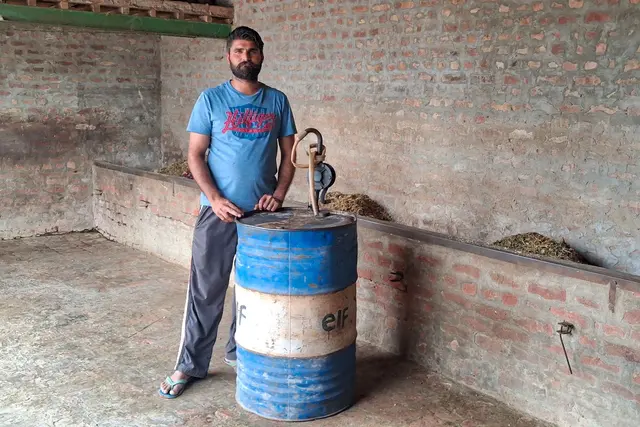
The custom harvesters face a bigger challenge. Like Lakhwinder Singh, 31, who owns five acres of land in Patti village, and finds that his own farm is not able to sustain his life. Last year he bought a combine harvester – 100 percent loan-financed – for Rs. 12 lakh. A great risk for one who earned just Rs. 1.5 lakh from both harvests the previous year.
Apart from that, he owes Rs. 3 lakh to the village cooperative bank. Every six months, he has to pay an instalment of Rs. 1 lakh to the financer. Now, he has sought Rs. 20,000 from his arhtiya (commission agent-cum-moneylender) to buy diesel. “The harvesting season lasts just 20 days now. I can’t afford to have the machine remain idle for a single day in those three weeks. If I fail to pay the instalment, I’ll end up losing the harvester to them,” he says.
Loan-burdened rural Punjab is moving further down the debt trap. A December 2025 study by the Punjab State Farmers’ & Farm Workers’ Commission found that the state’s cultivators owe around Rs. 1.04 lakh crore to banks and around Rs. 20,000 crores to moneylenders. Rural debt has seen a fivefold increase in the past two decades. The war is set to push these already unimaginable figures even higher.
Even if the diesel drum is full – paid for with crushing debt – or his son returns from Cyprus, Dalbara Singh knows more lies ahead. If the harvest goes smoothly, it will be followed by sowing. “I have heard, just like diesel, the fertilisers also come through the same route?” he asks. A question to which the government surely owes an answer.